Pick a topic or search. Every answer uses TK’s own presentations and project records; where a number depends on your part, the answer says so.
Who is TK Mold USA, and who actually builds the mold?
TK Mold USA is how North American buyers reach TK Group (Holdings) Ltd., a mold maker founded in Hong Kong in 1983 and listed on the Hong Kong Stock Exchange since 2013 (2283.HK). TK has more than 4,800 employees and 500 engineers, net sales of about USD 303 million, and capacity for more than 2,000 molds a year. Molds are designed and built in TK’s own tool shops in Shenzhen and Suzhou, and TK is ranked the No. 1 export toolmaker in China. See
equipment and facilities.
Why source a mold from TK instead of a U.S. mold shop?
Capacity and build time. TK runs about 350 sets of mold making equipment and builds more than 2,000 molds a year, so a typical TK build takes 3 to 6 months where TK’s comparison puts EU and U.S. toolmakers at 8 to 18 months. That matters most on high cavitation, stack, two shot and multi mold programs, such as twelve 128 cavity molds TK finished in 6 months. For a simple tool you need in a few weeks, a local shop, or TK’s 3 to 5 week pilot mold, may be the better fit, and Brandon will tell you so.
How is TK different from an unknown overseas shop or a broker?
You can check TK. It is a public company that has published its ESG report on the HKEX website for seven years, holds ISO 9001 since 1999, ISO 14001, ISO 45001, IATF 16949 since 2021 and ISO 13485 since 2010, with a GMP statement since 2019 and an AEO advanced certificate from Shenzhen Customs since 2023, and is a member of the SPI in the U.S. Each project gets one account manager and one project manager who speak English (German, Spanish and French are also covered), and Brandon is your contact in the Americas.
What does Brandon Henderson do on my project?
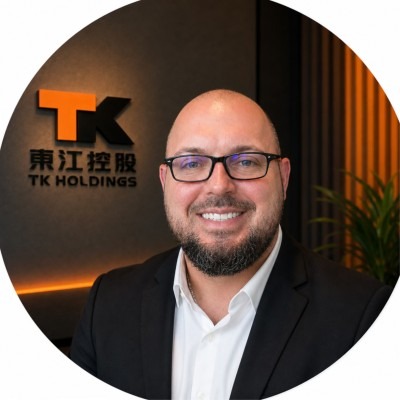
Brandon is TK’s Technical Sales Support Manager for the Americas, based in North Carolina. He is a Journeyman Tool and Die Maker and CPSP with more than 15 years in custom injection molding. He reviews your part and RFQ, works with TK’s project manager through DFM, design review and trials, joins the trials with your team, and goes through the samples, measurements and changes with you, in your time zone.
How is my CAD and intellectual property protected?
Put an NDA in place before you send files; send yours with the RFQ or ask Brandon for TK’s. TK builds molds for global brands in medical, packaging, personal care, electronics and automotive, works under certified quality systems including ISO 13485 and IATF 16949, and as a listed company answers to the Hong Kong Stock Exchange. You can also limit what you share: a quote only needs the part model and print, not your product assembly.
What do I have to share to get a quote?
For a firm quote: the 3D model of each part, a 2D print with tolerances, the resin, annual volume, and the press the mold will run in. Target cavitation, cycle time, mold standards and delivery terms make it more accurate. If you are not ready to share all of it, Brandon can give a budget number from less and firm it up once the rest is in. The
RFQ checker below lists what is missing.
Which CAD file formats does TK accept?
STEP (.stp or .step) and IGES (.igs) work for every project. TK designs molds in Siemens NX (UG) with more than 100 licenses, so native NX files open directly. Add a 2D print as PDF that shows tolerances, critical dimensions, surface finish and where gates, ejector marks and parting lines may or may not go.
What does TK’s DFM and Moldflow review cover?
TK has offered early DFM support since 2010. The review covers wall thickness, gate location, parting line, draft, ribs and undercuts, then Moldflow fill, cooling, mold temperature and warpage studies, run in Autodesk Moldflow by analysts certified at Gold, Silver and Bronze level. Problems found here are fixed in the part design before steel is cut, which is cheaper than any mold change. See
DFM and Moldflow.
What drives the price of an export mold?
Mostly the part and the volume: part size and complexity, slides, lifters and unscrewing cores, cavitation, hot runner type, two shot or stack construction, steel and surface finish, and tolerances. Your plant standards (component brand, water threads, hot runner wiring) and the delivery terms add to it. That is why a complete RFQ gets a tighter quote than a part file alone.
How long does an export mold take?
A typical TK build takes 3 to 6 months, against 8 to 18 months at EU or U.S. toolmakers in TK’s comparison. Documented TK projects: a 72 cavity flip top cap mold and a 12+12 two shot pull ring cap mold each shipped 10 weeks after the PO, a 32+32 stack mold for a container base shipped 16 weeks after kickoff, and twelve 128 cavity molds were finished in 6 months. Your time depends on the part, the cavitation and how fast design release and sample approval happen on your side.
Is there a faster option for prototypes or a pilot mold?
Yes. TK builds fast pilot molds in 3 to 5 weeks on a prepared mold base and hot runner, using the same stack design as the production mold, so the lessons carry straight into the production tool. For single shot LSR parts, TK offers a 2 week prototype service on a standard mold base with a cold runner.
How will I know where my mold is during the build?
TK sends a weekly tooling progress report with machining photos from kickoff through delivery, plus the trial out report after each trial. Design reviews can be held at your site or online, and TK runs remote support on RealWear AR headsets for design and DFM reviews, progress checks, mold trials and sample inspection, so you see the mold from the toolmaker’s point of view.
How do the time zone and language work?
Shenzhen is 12 hours ahead of U.S. Eastern time in summer and 13 hours in winter, so a question sent at the end of your day is usually answered by the next morning. TK’s account and project managers work in English, and Brandon covers U.S. business hours for calls, reviews and anything that needs a quick decision.
How do I know the mold works before it ships?
Every TK mold is trialed on TK’s own presses using a ten step standardized debug procedure that optimizes injection, holding and temperature settings, then qualified with data captured before and after molding to set a stable process window. Samples are measured on CMM and optical measuring machines; on electronics molds TK holds CPK above 1.33 on more than 200 dimensions. You approve the samples, or request changes, before the mold is released to ship. See
mold trials.
Can my team watch the mold trial?
Yes. TK runs online mold testing, sample checks and mold validation before shipment for customers who cannot travel, and you are welcome to attend in person. Brandon joins the trial with your team and goes through the results and any changes with you afterward.
What presses does TK use for trials?
TK’s mold testing center has 18 trial presses, 6 of them set up for two shot molds, from brands including Arburg, Fanuc, JSW, Milacron, Krauss Maffei, Husky, Netstal and Engel. Trial presses run up to 1,500 T, with 2,000 T, 2,100 T and 2,800 T presses for large automotive molds. Ask for a press close to yours so the trial settings carry over.
How do I know the steel and heat treatment are what I specified?
Ask for the paperwork. Certification and documents ship with every TK mold, and on TK builds this has included the steel maker’s material certificate and the heat treater’s QC report with hardness results for the inserts. TK also works with established suppliers for steel, heat treatment and hot runner systems. See
custom injection mold tooling.
Will the mold run in my U.S. press without rework?
It should, if your plant standards are in the RFQ. TK designs export molds around your press: inch locating ring and sprue radius, tie bar clearance, shut height and knockout pattern, NPT water threads with your couplers, DME, HASCO, Progressive or Meusburger components, and hot runner wiring and connectors to your controller standard. See
export molds for U.S. presses.
How is the mold packed and shipped?
Molds are vacuum packed and shipped by air, boat or rail, with certification and documents included. TK can deliver turnkey, with mold, parts and process production ready at handover. Air is fastest for a tool you need right away; ocean costs less for heavy molds. Agree the Incoterms on the quote so everyone knows who handles freight, customs and insurance.
Who helps when the mold arrives at my plant?
TK sends a team for on site start up and tear down: a project manager, an account manager, a senior toolmaker and a senior process engineer, who hold visas for the trip. They average 15 years with TK. After start up, TK’s global after sales service and Brandon stay with the mold.
What about repairs and spare parts later?
Each export mold ships with 2D and 3D mold drawings and a recommended spare parts list, and standard components can be bought from your usual distributor. TK offers tool repair and spare parts service, and the TK Vietnam plant has its own tool repair shop.
How do U.S. tariffs affect a mold imported from TK?
Duty on an imported mold depends on its tariff (HTS) classification and its country of origin, and U.S. tariffs on goods from China have changed many times since 2018. TK builds molds in China, so check the current rate with your customs broker before you place the PO and include it in your landed cost. Ask for the HTS code to appear on the quote and the commercial invoice. TK holds an AEO advanced certificate from Shenzhen Customs, which helps exports move through customs.
What does TK Vietnam do?
TK Vietnam is a molding plant in VSIP, Hai Duong province, 30 minutes from Hanoi airport and about 1.5 hours from Haiphong harbor. It was set up in 2021 and has run since 2022, with about 10,000 m² of floor space, around 200 people, injection molding including two shot, secondary processes such as printing, laser etching and ultrasonic welding, and a tool repair shop. It holds ISO 9001, ISO 14001, ISO 45001 and UL certification. It is not a full mold build plant: new molds are built in TK’s China tool shops.
Can TK mold my production parts too, or only build the mold?
Both. TK’s molding plants run 503 injection molding machines, including two shot, three shot, LSR, vertical and high speed presses, with insert molding, IML and IMD, spray painting, printing, ultrasonic welding and assembly. You can have TK build the mold and ship it to your plant, or build it and mold the parts. See
contract injection molding.
Which industries and part types does TK build molds for?
Medical and diagnostics, packaging, caps and closures, personal care, consumer electronics, connectivity and automotive. Typical work includes high cavitation molds up to 256 cavities, stack molds, two and three shot molds, unscrewing molds, LSR and insert molds, and large automotive molds. See
capabilities.
No questions match that search. Try a shorter word, or ask Brandon directly below.
 Skip to content