
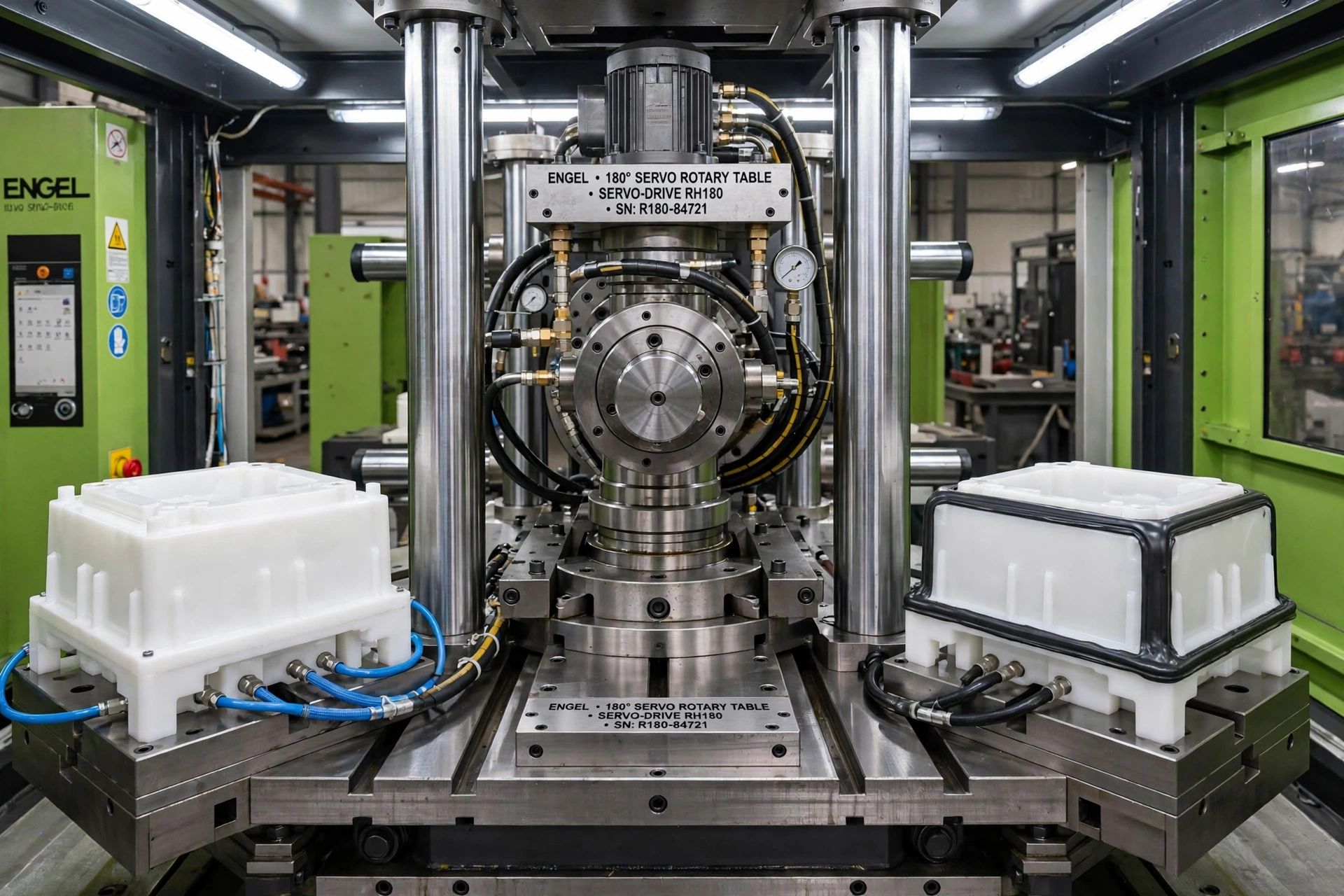
Rotary Platen and Transfer Kinematics
In standard single-shot molding, adding a soft grip, gasket, or clear viewing lens requires molding the plastic housing first, transferring it by hand into a second mold, and shooting an overmold. This manual process risks contamination, handling damage, and parting line flash.
Benefits of Integrated 2K Tooling
Multi-shot injection tooling consolidates multiple parts into a single molded assembly, providing significant manufacturing advantages:
- Zero Labor Assembly: Integrates elastomeric seals, dampeners, and cosmetic soft-grips without secondary glues or manual snapping.
- Permanent Molecular Adhesion: Hot molten elastomer cures directly against the still-warm primary substrate, creating a permanent fusion bond.
- Hermetic Ingress Protection: Achieves certified IP67 and IP68 waterproof enclosure ratings for medical handsets and consumer wearables.
Polymer Chemical Compatibility and Thermal Bonding
Achieving a permanent molecular bond between two polymers requires careful matching of melt temperatures, polar surface energies, and chemical structures. Incompatible polymers separate under minimal mechanical shear.
| Primary Substrate (Shot 1) | Secondary Material (Shot 2) | Adhesion Strength | Primary Industrial Application |
|---|---|---|---|
| Polycarbonate (PC) | TPE (Urethane-based TPU) | Superior (Chemical Fusion) | Consumer electronic cases, impact bumpers |
| ABS / PC-ABS | TPU / TPE-V | Excellent (Molecular Fusion) | Power tool handles, automotive trim switches |
| Polypropylene (PP) | TPE (Olefin-based TPV) | Superior (Direct Polymerization) | Living hinge containers, toothbrushes |
| Nylon (PA66-GF30) | Modified Specialty TPE | Good (Requires Heat Control) | Under-the-hood engine shrouds, pump covers |
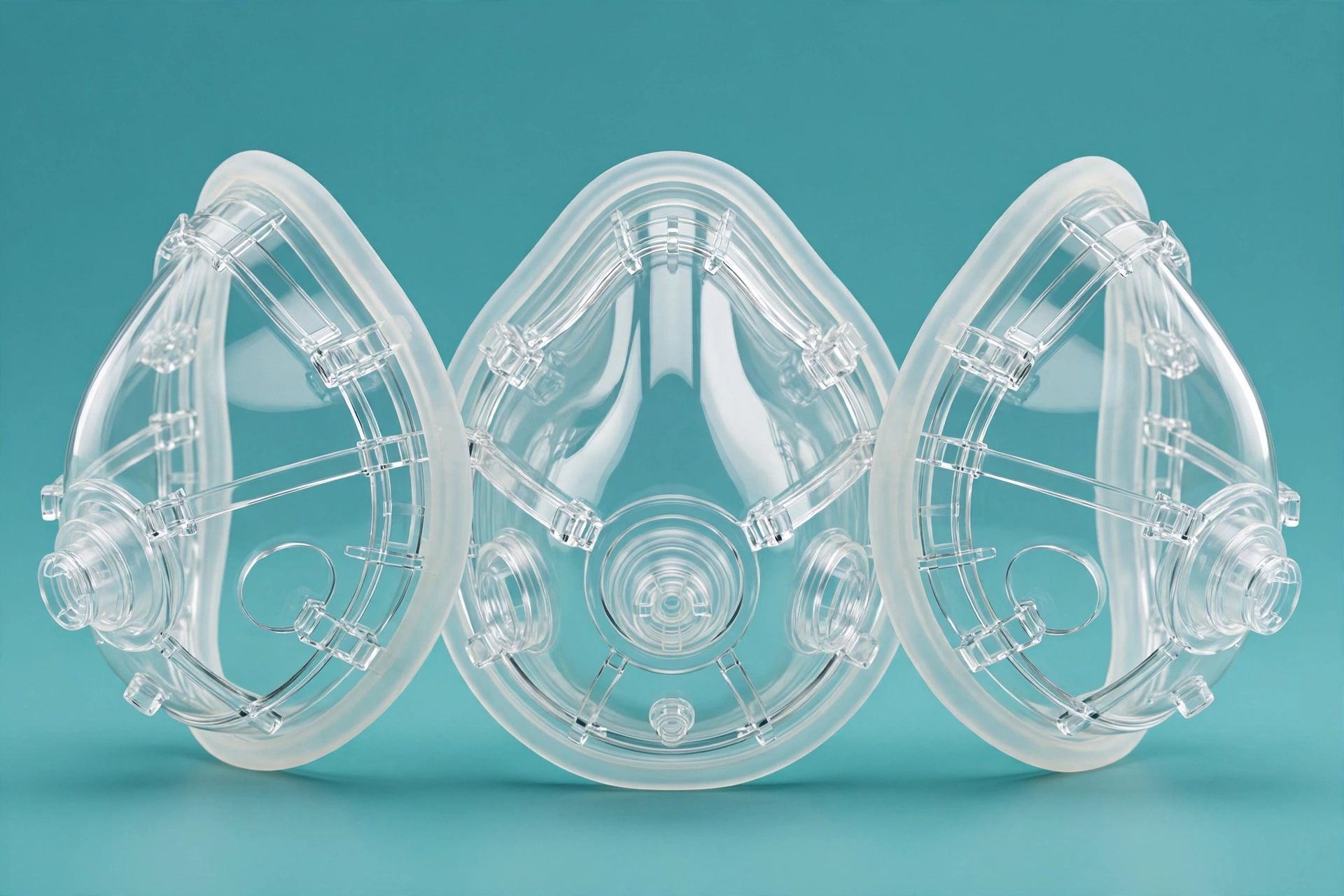
| Polycarbonate (PC) | Liquid Silicone Rubber (LSR) | High (Requires Primer/Self-Adhesive) | Medical respiratory masks, optical seals |
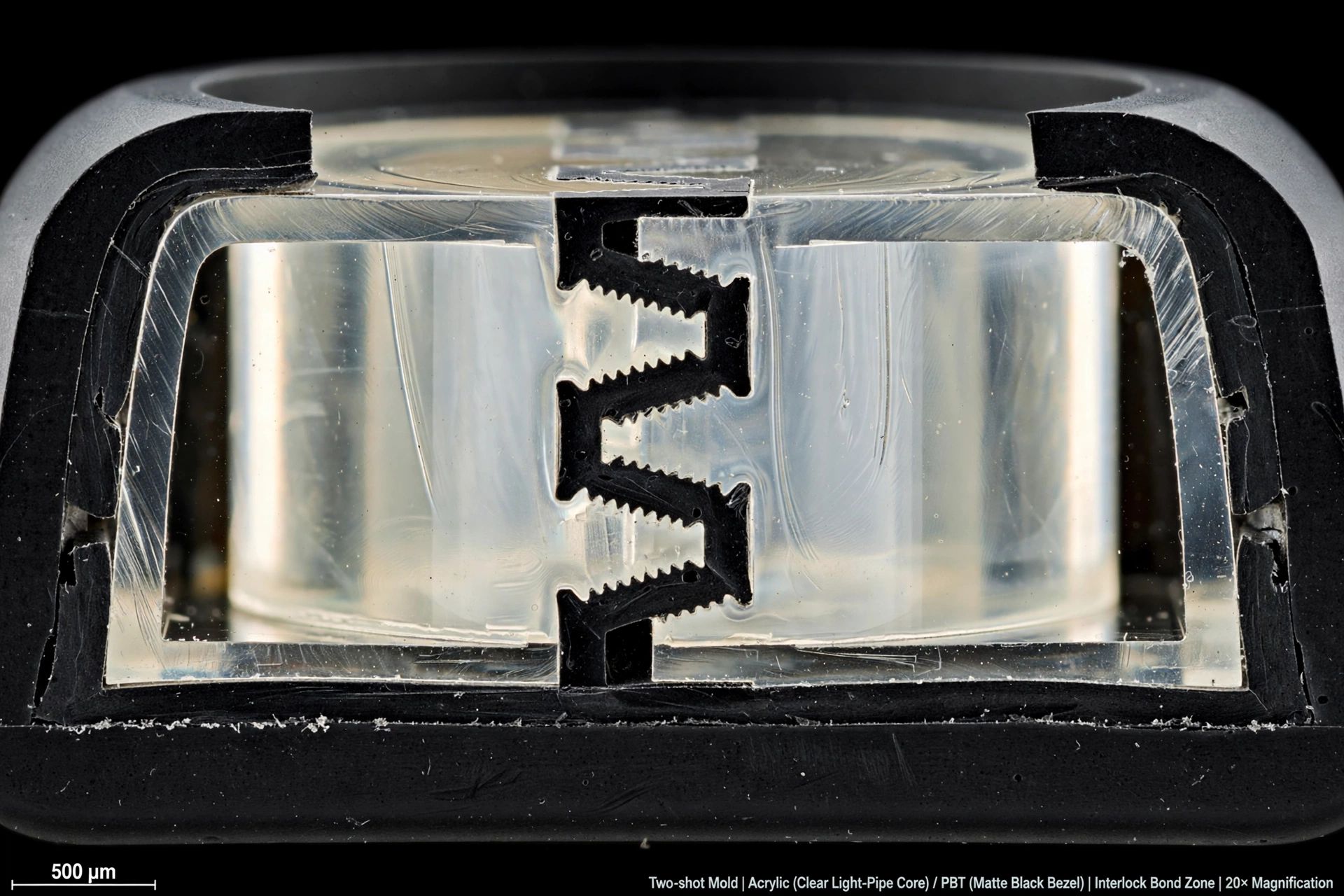
Mechanical Interlocks for Critical Joints
When molding inherently incompatible polymers (such as standard Nylon and unbonded silicone), our engineering department incorporates mechanical undercut holes, dovetail grooves, and pass-through channels. This ensures a permanent physical lock even under aggressive thermal cycling. Explore our DFM and Moldflow engineering review for joint optimization.
Liquid Silicone Rubber (LSR) Multi-Shot Molding
Cold Deck and Heated Mold Dynamics
Liquid Silicone Rubber requires an inverse thermal profile compared to standard thermoplastics. While thermoplastics are melted in a heated barrel and frozen inside a cooled mold, LSR components enter the mold chilled (15°C to 20°C) and vulcanize inside a heated steel cavity (170°C to 200°C).
TK Mold USA manufactures specialized multi-shot tooling integrating thermally insulated barrier plates that maintain precise temperature differentials between the cold thermoplastic runner and the vulcanized silicone cavity.
Interactive Polymer Compatibility Selector
Choose your primary rigid substrate and target secondary material to check expected chemical adhesion and recommended processing temperatures.
Technical Sourcing FAQ: Multi-Shot Tooling
Developing a Two-Shot or Overmolded Assembly?
Consult with Brandon Henderson in North Carolina to evaluate your dual-material bonding requirements, press kinematic options, and tooling layouts.