 Skip to content

Food and Beverage Packaging Molds TK Builds
A food packaging mold earns its keep in fractions of a second. It runs around the clock for years, often with several versions of the same part, and a small change in cycle time or cavitation moves the cost of millions of parts. TK’s food and beverage molds are built around four things: single shot or two shot (2K) molding, quick version change, short cycle times, and fast pilot development for new products.

Stack Molds for Container Bases, Lids and Caps
A stack mold puts two sets of cavities back to back with a center section between them. Both faces fill in the same shot and share the same clamp, because the melt pressure on one face pushes against the other, so a 32+32 stack makes about twice the parts of a 32 cavity mold on a press of similar size. The center section carries the hot runner, fed through a sprue bar from the machine nozzle, and a rack and pinion opens both parting lines together.
Food and Beverage Stack Molds from TK’s Case Files
| Part | Cavities | Size, resin, weight | Mold size (mm), weight | Press | Cycle |
|---|---|---|---|---|---|
| Juice jug flip lid | 48+48 | ø69 x 45 x 9 mm, PP, 3.8 g | 1000 x 1300 x 1220, 13,250 kg | 1000 T | 12 s |
| Creamer bottle flip top cap | 24+24 | ø55 x 37 mm, PP, 12.8 g | 1000 x 1070 x 1300, 10,900 kg | 550 T | 12 s |
| Grated cheese container base | 32+32 | ø73 x 20 mm, PP, 8.2 g | 813 x 1220 x 1104, 8,400 kg | 500 T | 9.6 s |
| Grated cheese container lid | 32+32 | ø73 x 7 mm, PP, 5.8 g | 813 x 1220 x 1104, 8,400 kg | 500 T | 10 s |
| Square container lid | 6+6 | 105 x 128 x 13.2 mm, 0.55 mm wall | 900 x 1020 x 1090, 7,250 kg | 500 T | 7 s |
| 5 L oil bottle handle | 2 x 16 | 16 x 89 x 107 mm, PE, 8.5 g | 900 x 1300 x 740, 9,700 kg | 500 T | 11.5 s |
Data from TK’s packaging tooling case files. Cycle times are for those specific parts and resins.
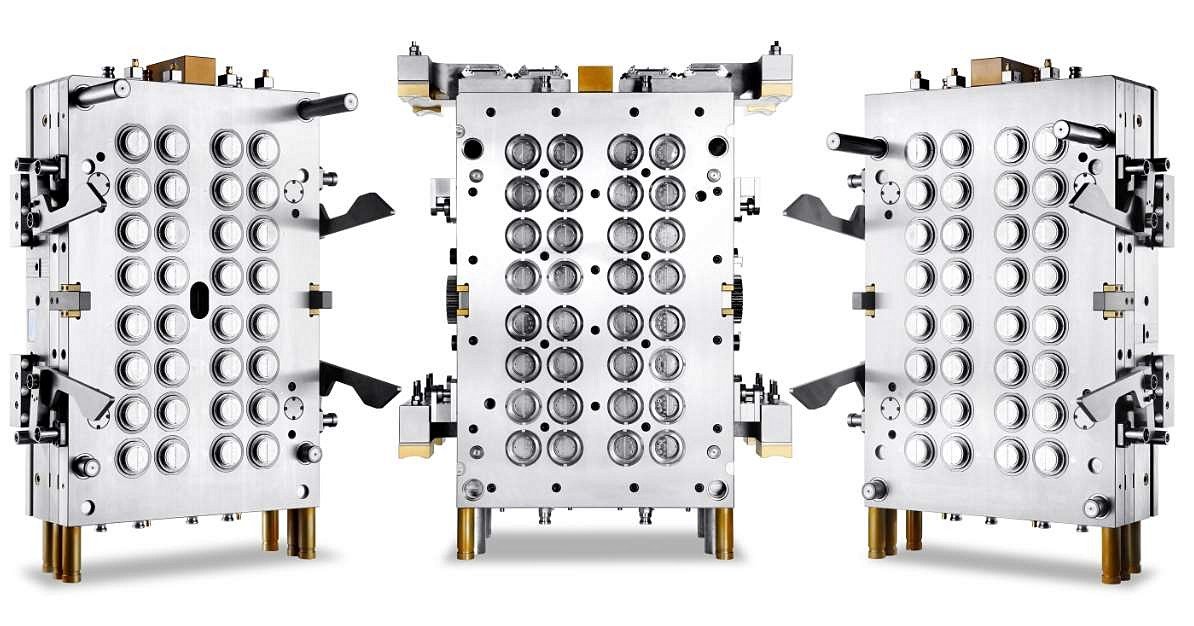
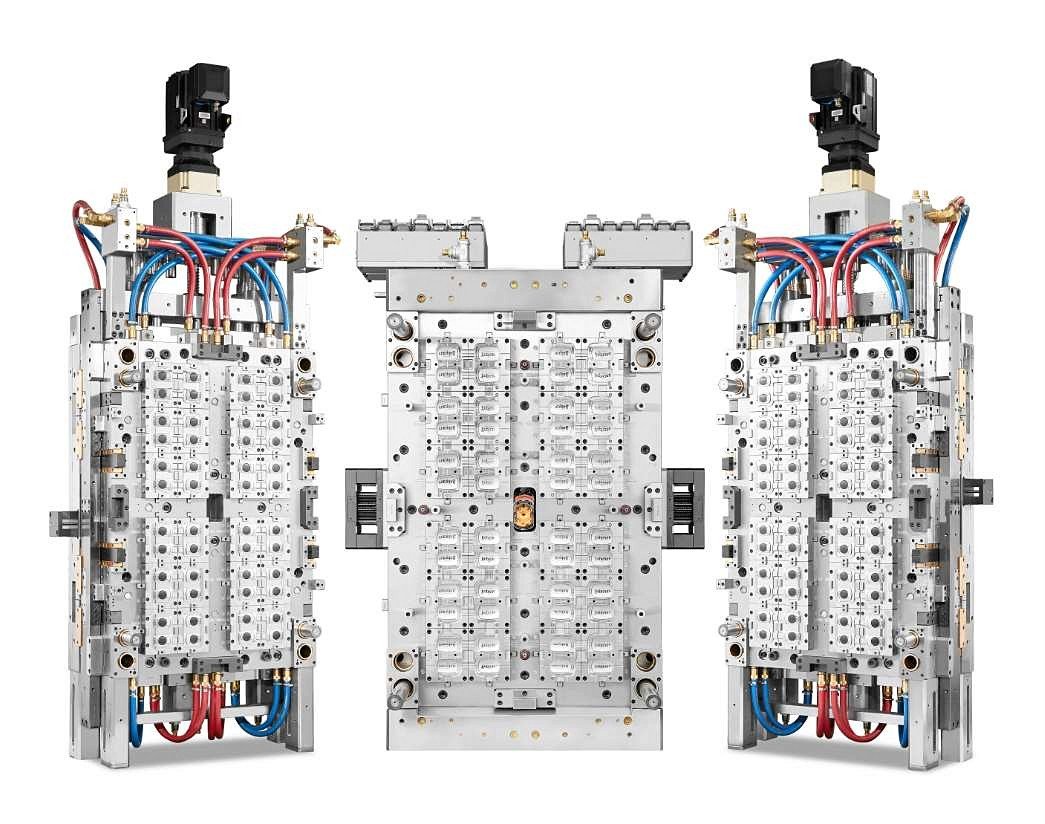
- The grated cheese base and lid molds share a full valve gate hot half that swaps between them.
- 16 weeks from kick off to shipment for the U.S. customer.
- The 48+48 juice jug lid mold uses full hot runner valve gate nozzles and a servo motor ejection system.
- Its cavity side can be changed with the mold still on the machine.
- TK has launched 8+8 stack molds as a package of 8 to 12 molds, delivered at the same time.
- See more on high cavitation and stack molds.
Thin Wall Containers and Lids
Thin wall food containers fill a long flow path through a wall under 1 mm before the melt freezes, so they are molded fast, in high flow PP, on high speed presses. The mold has to stay stiff under that injection pressure, vent well and cool evenly so a lid still snaps onto its base. TK tries out its thin wall molds on its own high speed presses, including a 400 T Husky and a 500 T Netstal SynErgy.
| Part | Size, resin, weight | Avg. wall | Cavities | Press | Cycle |
|---|---|---|---|---|---|
| 800 ml round container | ø114 x 99 mm, PP MFI 75, 36 g | 0.8 mm | 4 | 300 T | 6.0 s |
| Square container | 102 x 135 x 117 mm, PP MFI 75, 40.9 g | 0.8 mm | 4 | 400 T | 7.2 s |
| Square container lid | 105 x 128 x 13.2 mm, PP | 0.55 mm | 6+6 | 500 T | 7 s |
| Snack cup compartment insert | ø65 x 35 mm, PP, 14.9 g | 0.63 mm | 12 | 350 T | 8 s |
| Powdered milk flip top lid with spoon | 265 x 131 x 26 mm, PP, 25.5 g | 0.7 mm | 4 | 400 T high speed | 9.5 s |
The compartment insert mold has one hot half that runs two cold half sizes. The flip top lid mold, built for a customer in Spain, has interchangeable spoon inserts for 6 versions.


- Interchangeable inserts let one mold run several versions, such as six spoon versions in one lid mold.
- Shared hot halves let one hot runner side run two cold half sizes or a base and a lid.
- Matched sets: base and lid molds built and tried together so the fit is proven before shipment.
Food and Beverage Closures
Closure molds are where cycle time pays most. A 32 cavity tamper evident oil cap mold that cycles in 6 s makes about 150 million caps a year, and every tenth of a second matters at that rate. The mold has to release the threads and tamper bands cleanly, by unscrewing, collapsing or bump off ejection, and every cavity has to fill the same so the caps seal the same.
- 32 cavities, 6 s cycle.
- About 150 million caps a year.
- 32 cavities, 8 s cycle.
- About 112 million caps a year.
- 64 cavities, 6.1 s cycle on a 400 T press.
- Undercut stripped off the core, no unscrewing.
- 12+12 cavities, PP and TPE, 6.75 g, 420 T.
- Conformal cooling on the critical insert cut the cycle 22%. 10 weeks from PO to shipment.
- 24+24 stack mold, 12.8 g PP, 12 s, 550 T.
- Full hot side gating.
- 48+48 stack mold, 3.8 g PP, 12 s, 1000 T.
- Valve gates and servo ejection.

What Sets the Cycle on a Cap Mold
- Core cooling: the core is the hottest steel in a cap mold. TK uses Moldmax HH copper alloy core inserts and 3D printed conformal cooling to pull heat out faster.
- Thread release: unscrewing cores, driven by hydraulic or servo motors, or bump off ejection where the undercut allows it.
- In mold closing: flip top caps closed inside the mold before ejection, used on several of TK’s flip top cap molds.
- Balance: full hot runner valve gating and a short shot cavity imbalance study at trial, so every cavity fills alike.
More closure work is on the packaging and closures page.
Steel, Cooling and Clean Running
Food contact compliance comes from the resin and the molding plant, but the mold decides how cleanly and how long a food line runs. Food packaging molds often run on chilled water, so condensation on the steel is a real risk, and the steel grade, cooling layout and venting are set in the DFM review to match your plant.
- Tool steel from ASSAB, GMH Gruppe and Schmolz+Bickenbach, checked on arrival by spectral analysis and hardness testing. TK builds to your steel specification.
- Typical practice: corrosion resistant stainless mold steels are common for food packaging cavities and cores that see chilled water. The grade and hardness are confirmed in the DFM.
- Copper alloy inserts: Moldmax HH core inserts where heat has to come out of a small core fast.
- Conformal cooling: TK prints conformal cooling inserts in house, with cycle time cuts of up to 35%. See conformal cooling.
- Clean assembly: molds are assembled in a temperature and humidity controlled clean workshop, and inserts are machined to tolerance data so cavities interchange without hand fitting.

Pilot Molds, Version Changes and Mold Trials
New food packaging often changes after the first samples reach the filling line. TK builds fast pilot molds in 3 to 5 weeks on a prepared mold base and hot runner, with the same stack design as the production mold, so loops and risk come out of the pilot instead of the production tool.
How TK Qualifies a Packaging Mold
Product Function Lab
- Closure tests: torque, sealing, leakage and air leakage tests.
- Use tests: oil pouring and wall hanging tests.
- Conditions: high temperature, low temperature, negative pressure and shelf life testing.
- Dimensions: CMM, optical measuring and 3D scanning on molded parts.
Trials You Can Watch Remotely
- Remote support: mold design review, online mold testing, sample checks and mold validation before shipment.
- Trial presses: 18 test presses including 2K, with a 400 T Husky and a 500 T Netstal SynErgy for high speed packaging.
- Weekly reports from kick off through mold making and first trial, then global after sales service.
Food Packaging Mold Output Planner
Enter your yearly volume and how your line runs. The planner checks your demand against real food and beverage molds TK has built, shows how many molds like each one you would need, and works out the cavities you would need at that mold’s cycle time. Open “Show the math” to check every step.
Show the math
A first estimate for planning. Reference cavitation and cycle times are from TK builds for those specific parts and resins; your part’s cycle is set in DFM with Moldflow and confirmed at trial. Default numbers are an example only.
Technical Sourcing FAQ: Food and Beverage Tooling
Planning a Food or Beverage Packaging Program?
Send your closure or container drawings, resin, yearly volumes and press list to Brandon Henderson, Technical Sales Support Manager for the Americas. He will review cavitation, stack mold options, cycle time and version changes with TK’s packaging engineers.