
Case Studies: Injection Mold Tooling Programs
Discover how TK Mold delivers measurable cycle time reductions, superior part precision, and long tooling longevity. Review technical data and production outcomes from real injection molding tooling programs across medical devices, automotive optics, thin-wall food packaging, and consumer electronics.
Quick Overview: Measurable Tooling Program Outcomes
Across global automotive, medical, and packaging projects, TK Mold delivers mold tooling that drops cycle times by 20% to 48%, reduces scrap rates below 0.5%, and sustains millions of shots without premature core fatigue. By pairing Class 101 mold standards with advanced conformal cooling, diamond optical polishing, and comprehensive U.S. technical support, each tooling program achieves fast commercial launch and dependable high-volume production.
Case Study 1: Two-Shot (2K) Headlamp Outer Lens & Bezel
Challenge: Optical Clarity, Zero Weld Line Defect, and Rapid Rotary Indexing
A global Tier 1 automotive lighting supplier required a high-precision 2-shot injection mold for an LED headlamp outer lens assembly. The component integrated optical-grade Polycarbonate (PC) with an opaque black Polycarbonate/PBT structural bezel. The primary engineering hurdle involved preventing visual distortion and haze in the transparent PC optical window while maintaining sharp color transition boundaries with zero flash along complex contoured shutoffs.
Additionally, legacy production methods using independent sequential molding generated cycle times exceeding 58 seconds with a 6.8% scrap rate caused by dust contamination during secondary handling.
Tooling Engineering Solutions Implemented
- Rotary Platen Integration: Designed a precision center-pivot 180-degree rotary mold base compatible with Engel dual-shot injection presses, utilizing hardened guide bushings and hydraulic interlocks to guarantee sub-0.005 mm shot-to-shot alignment.
- Optical Grade Cavity Inserts: Fabricated lens inserts using ASSAB S136 ESR stainless steel vacuum heat-treated to 54 HRC, followed by automated 5-axis diamond fly-cutting and hand polishing to SPE #1 optical mirror standards.
- Dynamic Valve Gate Sequencing: Deployed a Synventive hot runner system featuring 8 individual servo-driven valve pins. Pin opening velocity and timing were profiled to eliminate pressure waves and freeze weld lines completely outside the visible optical zone.

According to testing standards outlined by the National Institute of Standards and Technology (NIST) on optical surface characterization, uniform mold surface roughness directly prevents refractive variance in molded polycarbonate. Post-launch production at the customer facility established sustained CPK values above 1.67 on all perimeter sealing dimensions.
Case Study 2: 128-Cavity High-Cavitation Blood Collection Tube Mold
Challenge: Concentricity, Thin Walls, and 24/7 Cleanroom Reliability
A medical diagnostics manufacturer required high-volume production tooling for vacuum blood collection tubes. The part geometry featured a 100 mm long cylindrical tube with a 0.65 mm nominal wall thickness molded in clear medical grade PET. The primary risk was core deflection under high injection pressures, which leads to uneven wall thickness, tube cracking during centrifugal spin tests, and vacuum seal failure.
Tooling Engineering Solutions Implemented
- Four-Point Interlocking Core Base: Each individual core pin incorporates a proprietary tapered 4-point mechanical interlock locking directly into the cavity block prior to resin injection, eliminating hydraulic core shift under 1,600 bar melt pressure.
- High-Efficiency Baffle Cooling: Internal micro-bubbler cooling tubes machined from beryllium-copper alloys circulate chilled water at 10 liters per minute per core, reducing cooling time to just 2.4 seconds.
- Pre-Hardened Interchangeable Tooling: All 128 core and cavity inserts were CNC ground to absolute tolerances within plus or minus 0.003 mm. Worn components can be replaced directly on the injection molding machine without bench fitting.

Case Study 3: Thin-Wall Food Tub with Conformal Cooling Inserts
Challenge: Eliminating Thermal Hotspots to Halve Cycle Time
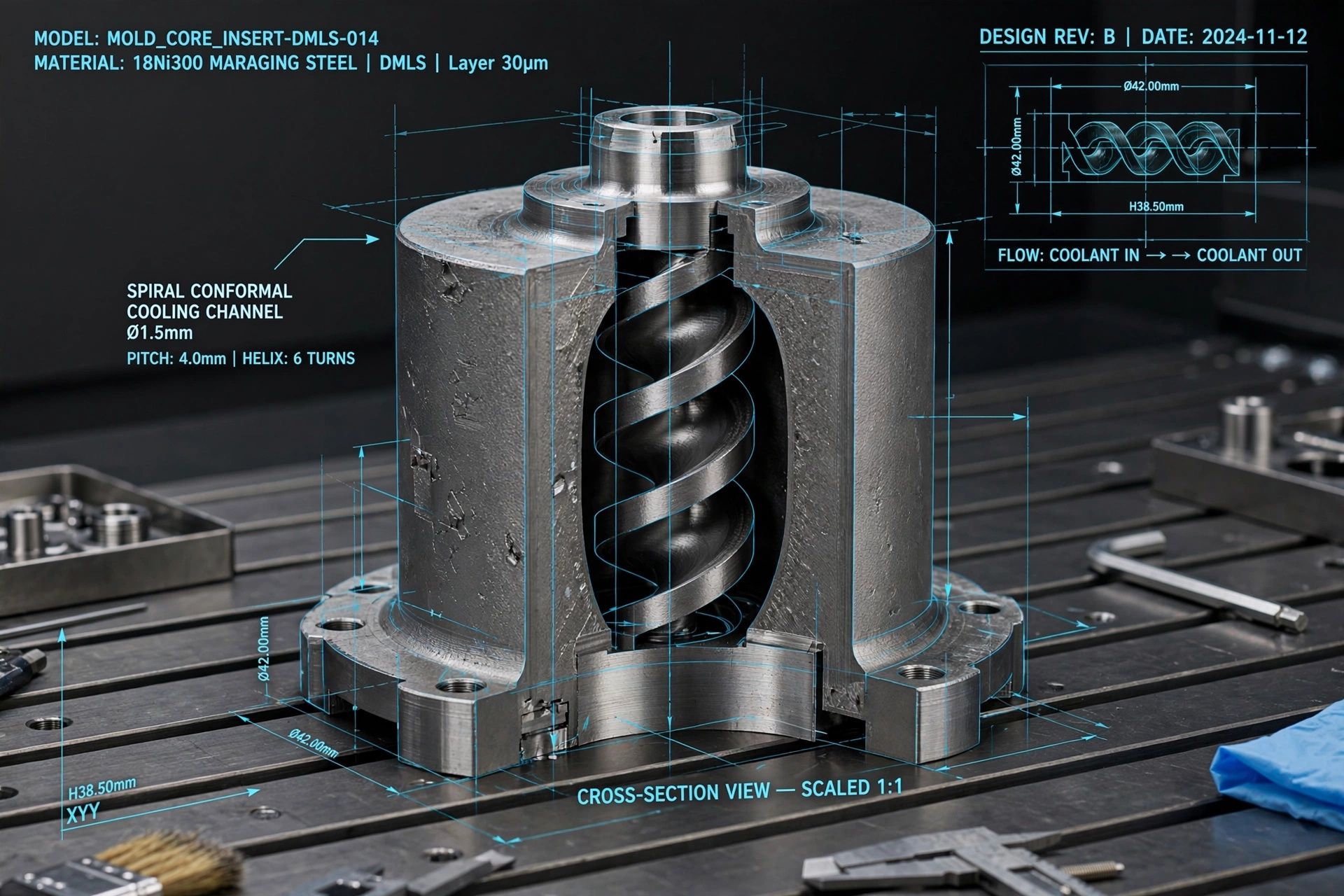
A contract food packaging molder was producing 500 ml polypropylene dairy tubs using conventional straight-drilled cooling channels. Deep thermal hotspots at the bottom corner radius limited cycle times to 7.4 seconds and created asymmetric thermal shrinkage that caused lid-sealing leaks on high-speed filling lines.
Thermal Comparison: Conventional Straight Drilling vs. Conformal Cooling
Case Study 4: In-Mold Structural Electronics (IMSE) Smart Band
Challenge: Low-Pressure Overmolding Over Flexible Printed Electronics
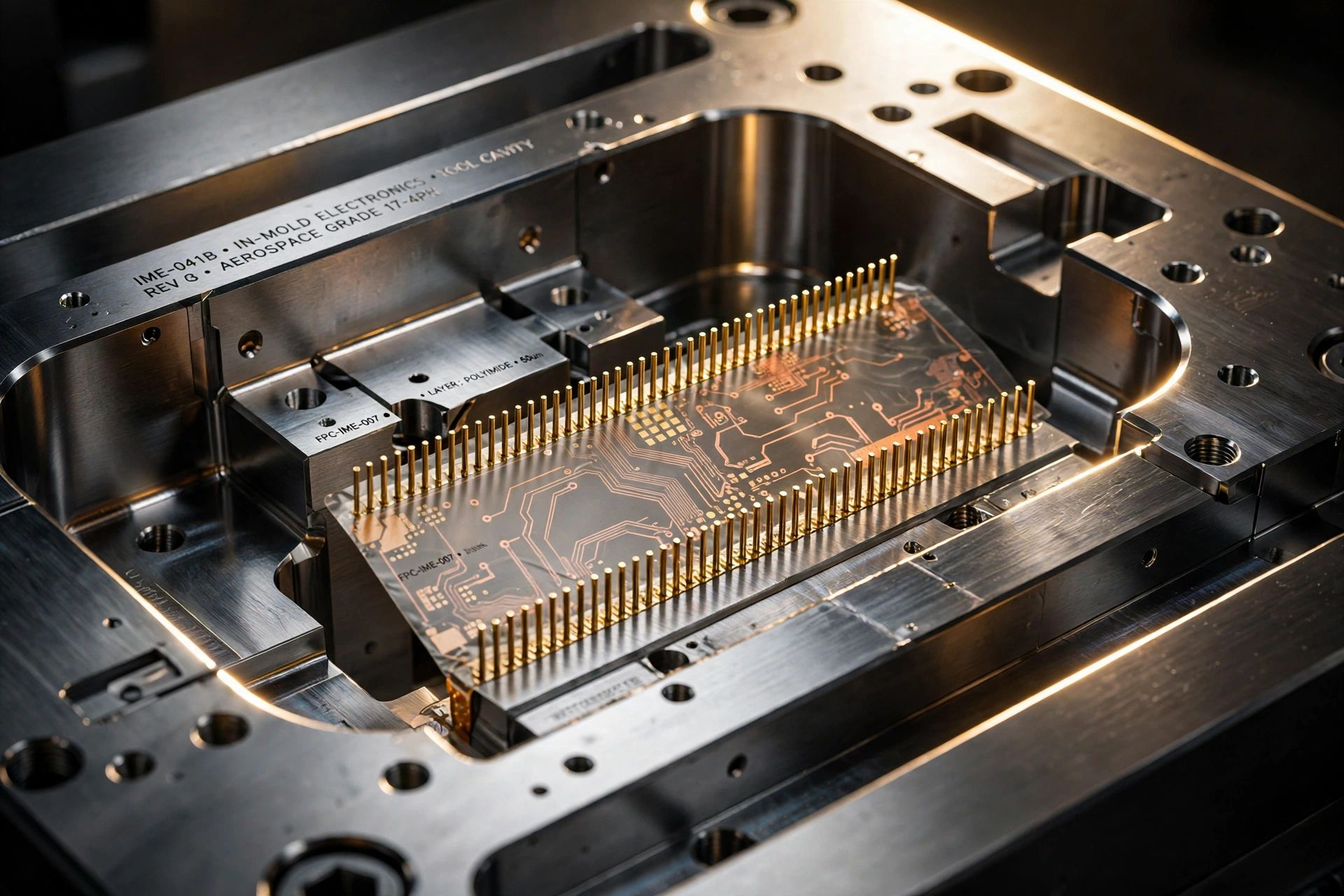
A consumer electronics OEM designed a water-resistant fitness tracker housing requiring direct encapsulation of flexible printed circuit boards (FPCBs) and micro-LEDs within a transparent optical polyurethane shell. Standard injection velocities washed away circuit traces or crushed delicate surface-mounted capacitors under hydraulic pressure spikes.
Tooling Engineering Solutions Implemented
- Progressive Rheology Gate Balancing: Configured fan gates with thickness tapers calibrated via Autodesk Moldflow Insight to maintain laminar flow fronts below 35 bar fill pressure around electronic components.
- Spring-Loaded Micro-Clamping Nests: Precision cavity nests mechanically clamp perimeter circuit tabs with constant 12 N force during platen closure, locking the electronics firmly against core shift.
- Thermally Balanced Vacuum Evacuation: Cavity parting lines incorporate micro-porous steel inserts and high-speed vacuum draw rings, venting 99.9% of cavity air before melt contact to prevent micro-bubble optical defects.
Tooling Program Benchmarks Across Manufacturing Sectors
Review quantifiable performance metrics across our primary tooling programs, demonstrating cycle reductions, scrap rate minimization, and mold maintenance intervals:
| Program Sector | Part Type | Legacy Baseline | TK Mold Result | Cycle Cut | Tool Steel Used |
|---|---|---|---|---|---|
| Automotive Optics | 2K Headlamp Outer Lens | 58.0 s cycle / 6.8% scrap | 42.5 s cycle / 0.4% scrap | 26.7% | ASSAB S136 ESR (54 HRC) |
| Medical Diagnostics | 128-Cav Blood Tube | 8.2 s cycle / ±0.045 mm | 4.8 s cycle / ±0.012 mm | 41.5% | AISI 420 Stainless (52 HRC) |
| Thin-Wall Packaging | 500 ml Polypropylene Tub | 7.4 s cycle / 1.8 mm warp | 3.8 s cycle / 0.3 mm warp | 48.6% | 1.2709 DMLS Maraging Steel |
| Consumer Electronics | Smart Band IMSE Housing | 28.5 s cycle / 12% scrap | 18.0 s cycle / 0.3% scrap | 36.8% | NAK80 High-Polish (40 HRC) |
| Industrial Equipment | Fiber-Reinforced Enclosure | 65.0 s cycle / severe sink | 44.0 s cycle / zero sink | 32.3% | Bohler M333 Isoplast (56 HRC) |
Tooling ROI & Production Cycle Time Calculator
Estimate annual machine hour savings and direct resin cost reductions based on your target annual volume, baseline cycle time, and anticipated tooling optimizations.
Frequently Asked Questions: Tooling Case Studies
Evaluate Your Program Against Proven Tooling Benchmarks
Review your upcoming injection mold tooling requirements directly with Brandon Henderson in North Carolina. We provide preliminary cycle time modeling, gate balance reviews, and Class 101 mold cost estimates within 48 hours.