
Machine Platen Alignment and Tie-Bar Clearances
When manufacturing export tooling for North American injection molders, mechanical compatibility must be engineered into the mold layout from day one. Many overseas mold makers build to metric standards commonly found in Asian presses, resulting in catastrophic fit problems when the mold arrives at a facility in Ohio, Michigan, or the Carolinas.
Critical Press Interface Variables
A reliable export mold matches the exact mechanical blueprint of the intended production machine. Critical alignment checks include:
- Locating Ring Diameter: Standard North American presses universally specify 3.990 inch or 4.000 inch diameter locating rings, unlike the 100mm, 110mm, or 120mm rings common in Asia.
- Tie-Bar Clearance: Mold base width and height must allow horizontal or vertical loading between tie-bars without removing mechanical slide cylinders.
- Knock-Out Pattern: Ejector plate drilled and tapped with standard U.S. pattern (such as 7-inch center line or SPI standard knock-out spacing) for press hydraulic ejector rods.
- Clamp Slots and Lifting Holes: Heavy-duty top and side hoist rings certified to lift the full mold assembly during crane transport.
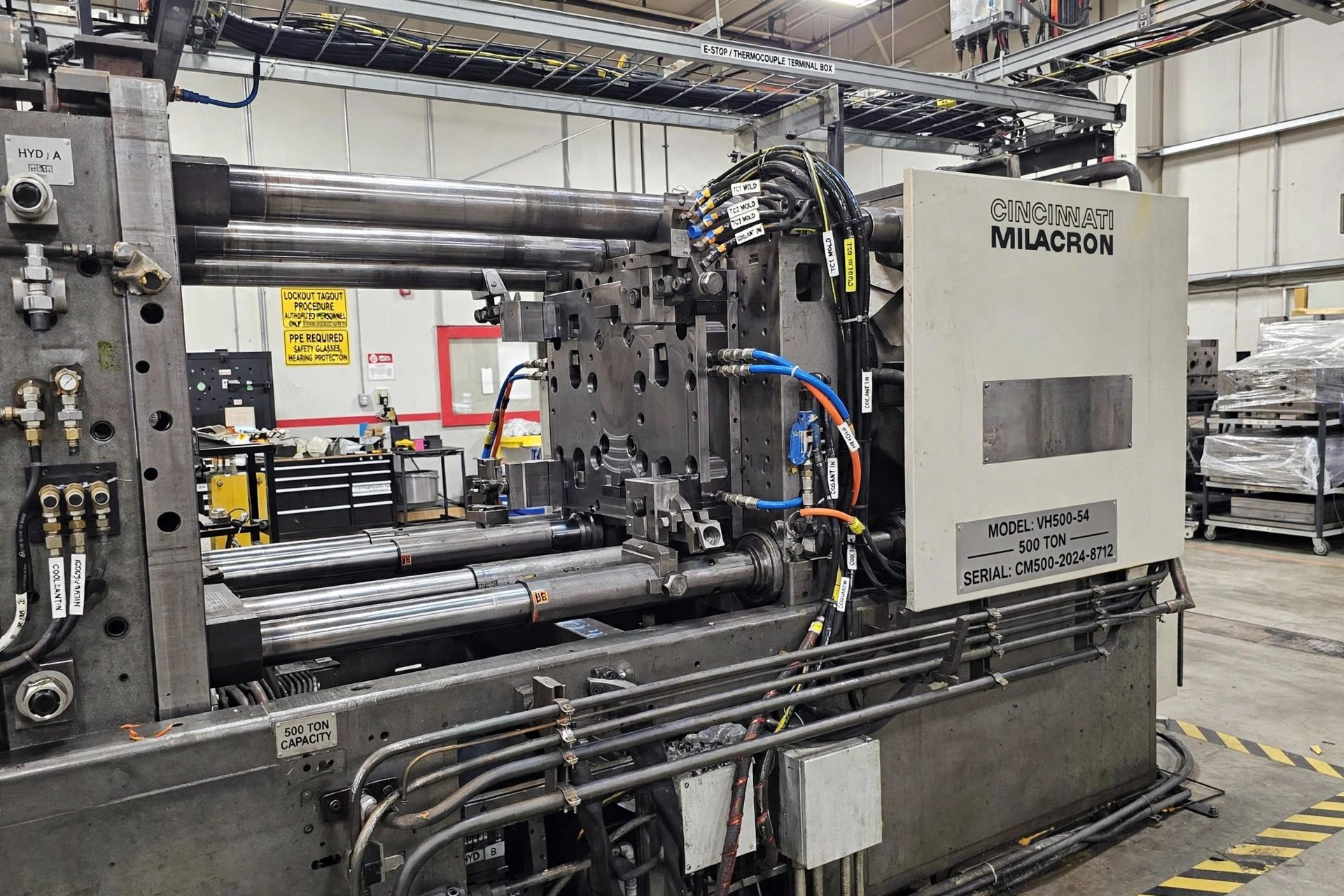
Manufacturing characterization data published by the National Institute of Standards and Technology emphasizes that mechanical alignment between machine platens directly governs uniform clamping load distribution. If an export mold does not seat flush against the platen, high clamp tonnage generates uneven platen deflection, inducing premature core pin wear and uneven cavity shutoff.
DME and HASCO Component Standards vs Asian Hardware
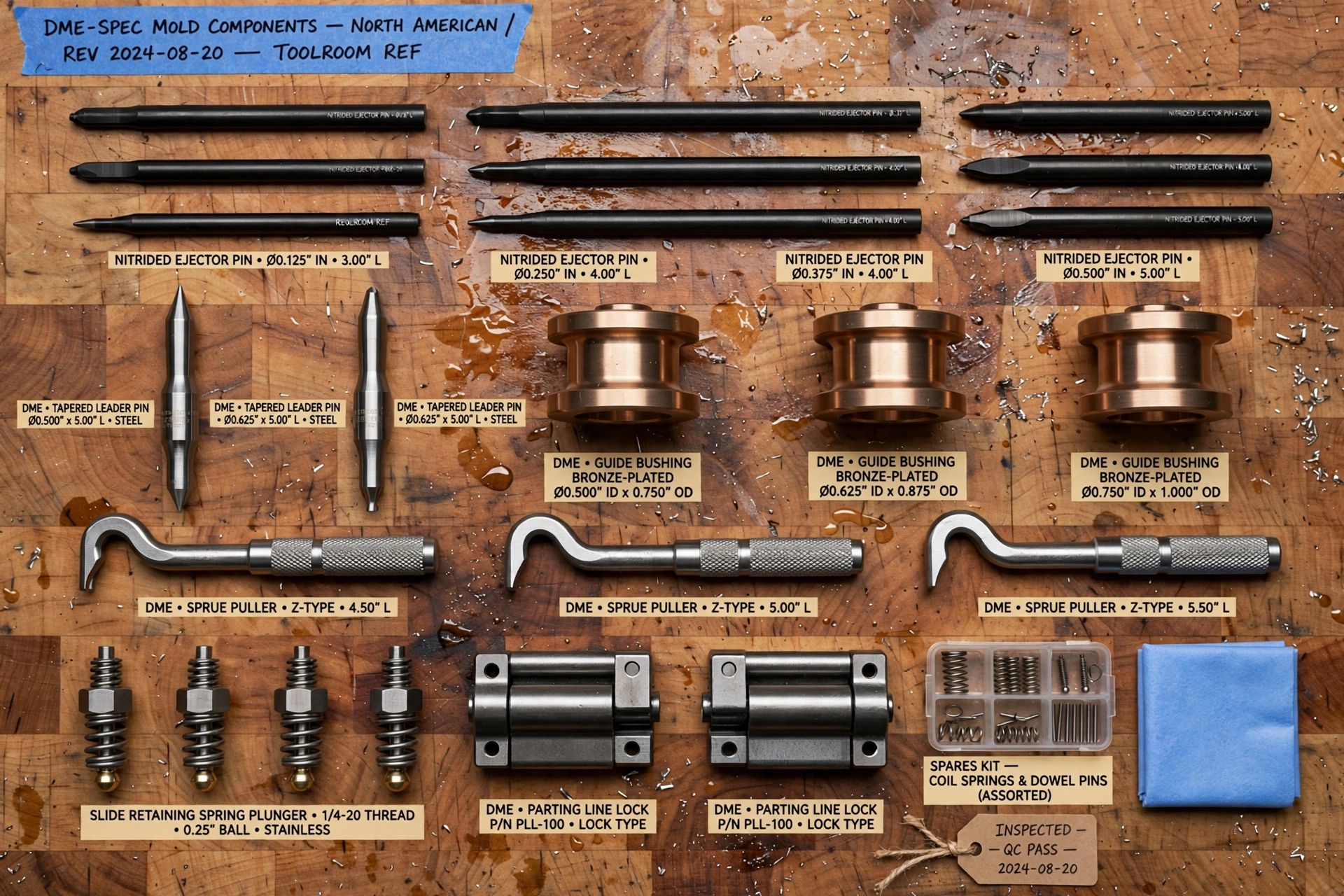
The primary reason North American tooling engineers hesitate to buy overseas molds is the concern over non-standard replacement parts. If a core pin breaks or a slide bushing wears out, waiting three weeks for replacement components from an Asian workshop halts customer production.
| Tooling Component | Typical Asian Domestic Standard | TK Mold USA Export Standard | Maintenance Advantage |
|---|---|---|---|
| Ejector Pins & Sleeves | Misumi metric or local non-standard | DME / Progressive inch or DIN standard | Next-day delivery from domestic distributors |
| Guide Pins & Bushings | Standard tolerance press fit | DME hardened alloy steel with bronze plating | Self-lubricating; prevents galling |
| Waterline Plugs & Fittings | BSPT / BSPP metric threads | Standard NPT threads with Jiffy-Tite couplers | Leak-free hookup to domestic chiller manifolds |
| Parting Line Locks | Friction locks or basic tapered interlocks | Progressive Components precision side locks | Sub-micron alignment; zero thermal galling |
| Electrical Connectors | Harting or Asian metric multipin | DME / Epic standard 16-pin / 24-pin connectors | Plugs directly into domestic temperature controllers |
Guaranteed Spare Parts Sourcing
Every export mold built by TK Mold USA comes with a complete bill of materials identifying exact commercial part numbers from domestic suppliers. If an ejector pin requires replacement after five hundred thousand cycles, your maintenance technicians order directly from DME or PCS Company using the part numbers on our assembly drawing.
For complex multi-cavity tools, explore our high-cavitation and stack molds or review our custom injection mold tooling capabilities.
Hot Runner Manifold Wiring and Controller Compatibility
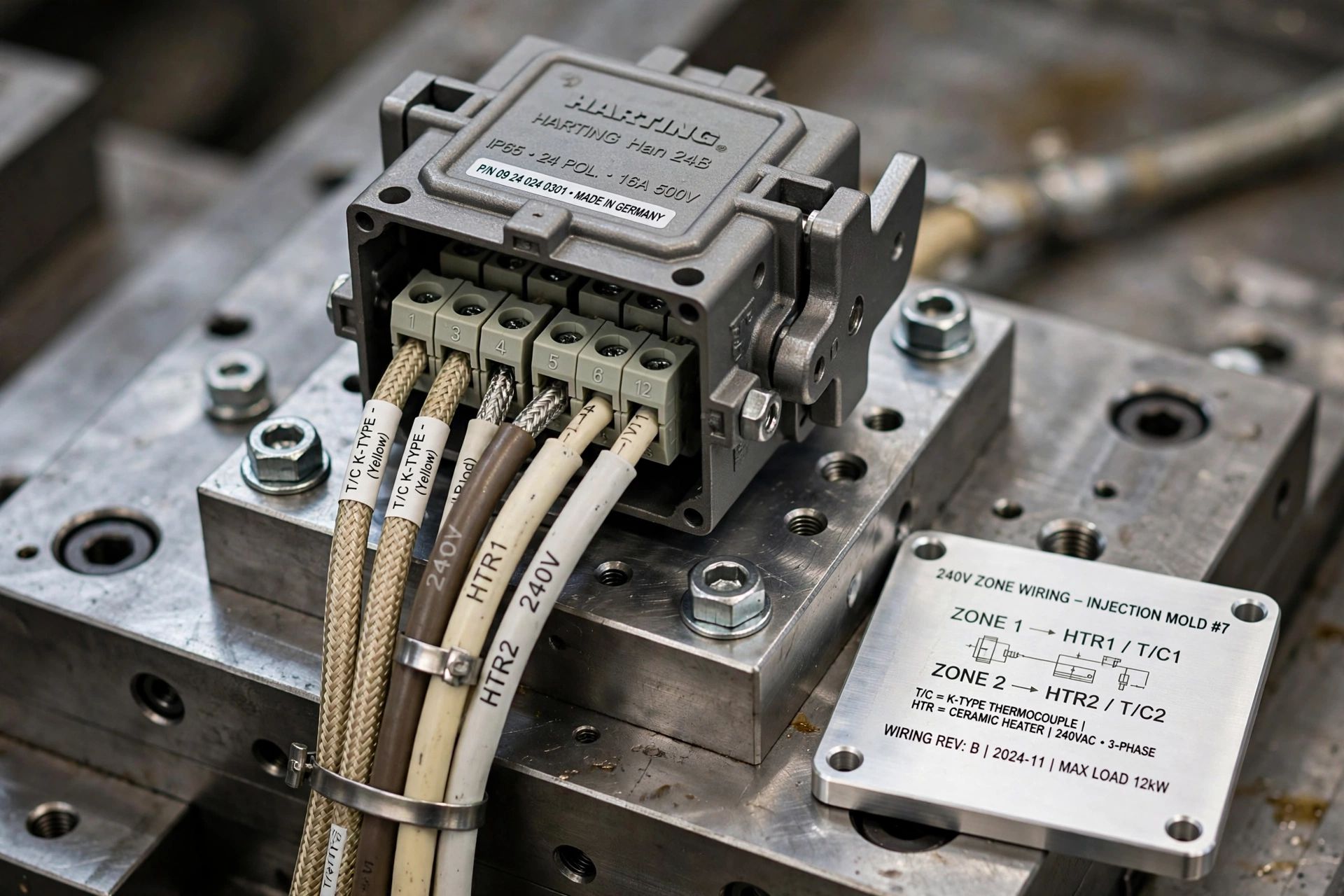
Hot runner integration is another area where non-export tools fail upon arrival. U.S. plants rely on centralized hot runner temperature controllers like Gammaflux, DME Smart Series, or Mold-Masters. Wiring an Asian manifold without conforming to standard pin configurations can burn out heater coils or blow main fuses.
North American Hot Runner Wiring Protocols
All export hot runner molds built for U.S. facilities are wired according to strict domestic industrial standards:
- Thermocouple Standards: Grounded Type J iron-constantan thermocouples standardly fitted unless Type K is specified by the customer.
- Connector Standard: Standard industrial 16-pin or 24-pin heavy-duty aluminum hood connectors mounted in an accessible junction box on the top or non-operator side.
- Zoned Terminal Labeling: Laser-etched identification plates matching physical zones to the electrical schematic diagram.
- Global Brand Manifolds: Husky, Mold-Masters, Synventive, INCOE, or Yudo systems with local North American field service networks.
Waterlines, Chiller Circuits, and NPT Fittings
Incompatible pipe threads cause persistent water leaks and wasted setup hours. While Asian shops use British Standard Pipe Taper (BSPT) or parallel (BSPP) threads, North American facilities exclusively use National Pipe Taper (NPT).
Every export mold built by TK Mold USA is CNC-threaded with 1/4″, 3/8″, or 1/2″ NPT pipe taps and supplied with brass Jiffy-Tite quick-disconnect sockets. Water manifolds are recessed into the mold base plates to avoid damage during crane rigging and transport. For extreme heat extraction on complex geometries, review our advanced conformal cooling technology.
Interactive Press Compatibility Specifier
Select your facility’s injection press tonnage to verify the standard export specifications applied during our tool design phase.
The Export Delivery Data Package
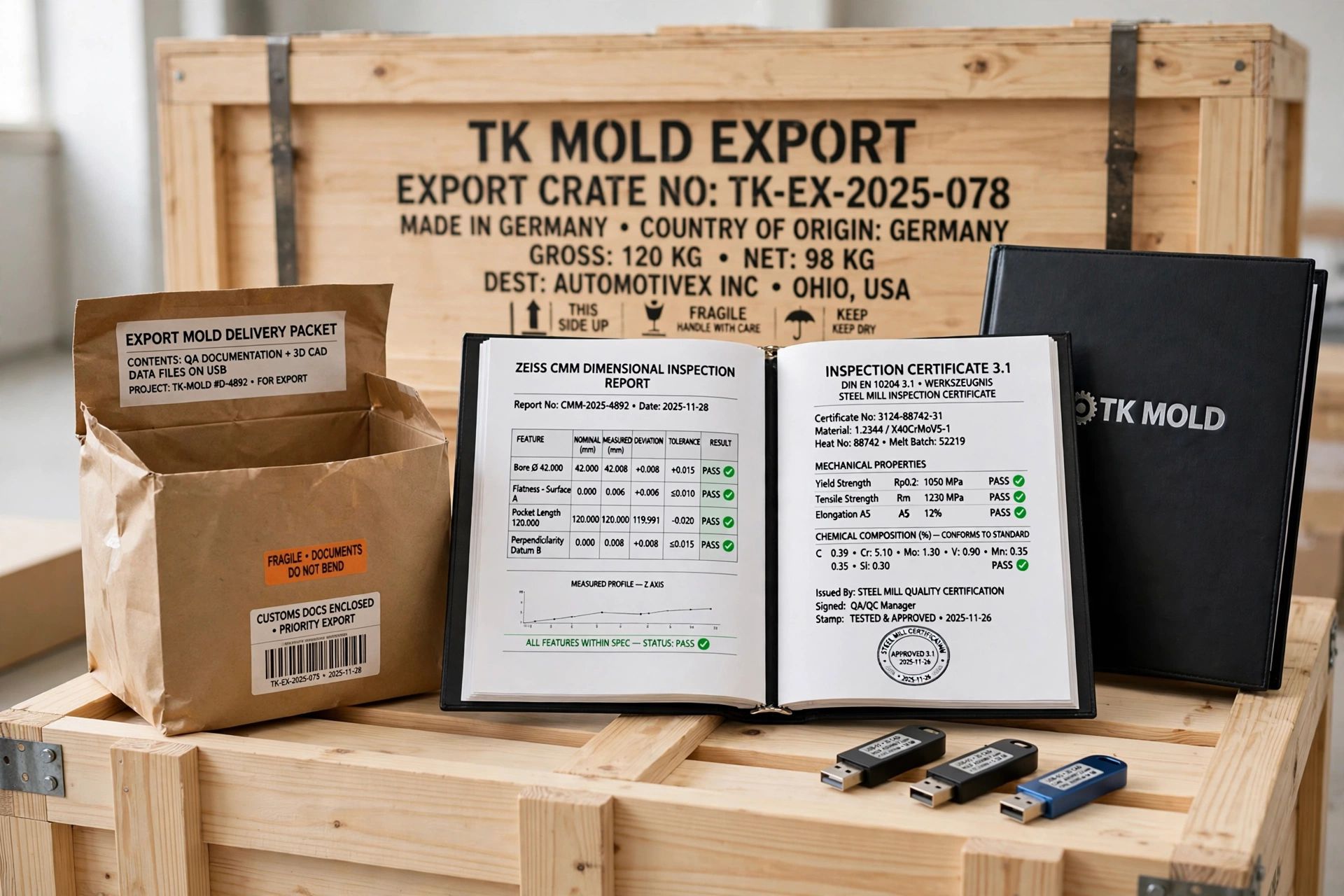
Every export mold shipped to North America includes comprehensive documentation designed for your toolroom and quality audit compliance:
- Steel Certifications: Original mill test certificates verifying chemistry and vacuum heat treatment hardness (HRC) for all cavity inserts and core blocks.
- 2D and 3D Assembly Files: Complete native 3D CAD files (STEP and Parasolid) and fully detailed 2D shop drawings with all BOM part numbers.
- CMM First Article Inspection (FAI): Detailed dimensional metrology reports for critical steel dimensions and molded T1 plastic parts.
- Scientific Molding Setup Sheet: Press parameters recorded during T1 trial, including fill time, peak cavity pressure, cooling temperature, and gate seal times.
- Spare Parts Kit: Complete kit containing backup ejector pins, springs, O-rings, and heater bands packed inside the crate.
To review our precision quality control laboratory equipment and automated CMM centers, visit our mold trials and quality verification page.
Technical Sourcing FAQ: Export Tooling
Have a Tooling Package Heading to a U.S. Plant?
Send us your injection press specifications and 3D part models. Brandon Henderson will perform a complete platen compatibility and DFM review to ensure flawless drop-in installation.